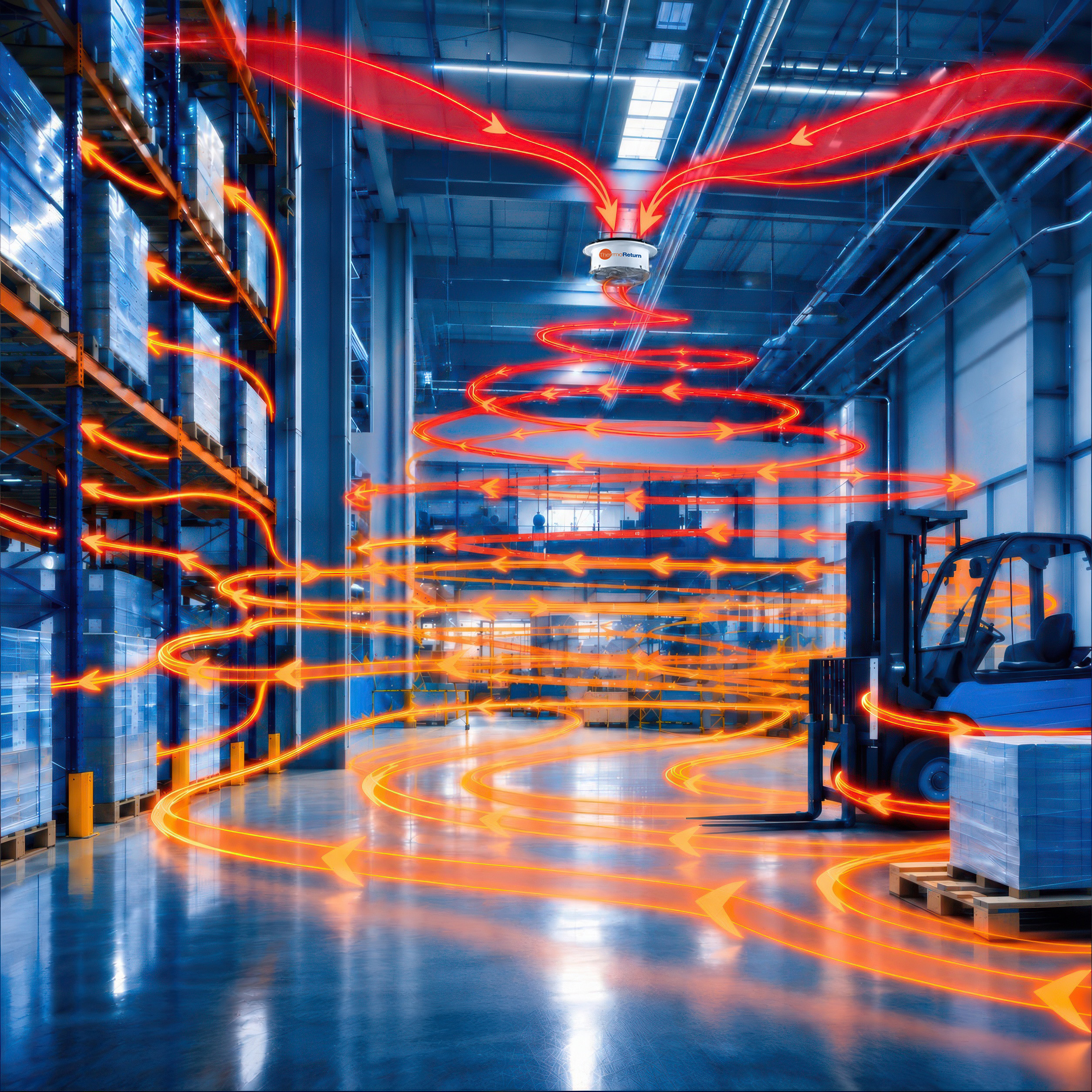
Less Heat Build-Up Beneath the Roof
Warm air accumulated near the ceiling is deliberately redirected into the occupied zone.
ThermoReturn improves indoor comfort, reduces heating costs and delivers noticeably greater efficiency throughout the year. This industrial ceiling fan is proven, innovative and features patented technology.
ThermoReturn circulates warm air accumulated beneath the ceiling downwards in spherical-radial patterns. Heat is distributed much more evenly throughout the space, potentially reducing daily heating operating times.
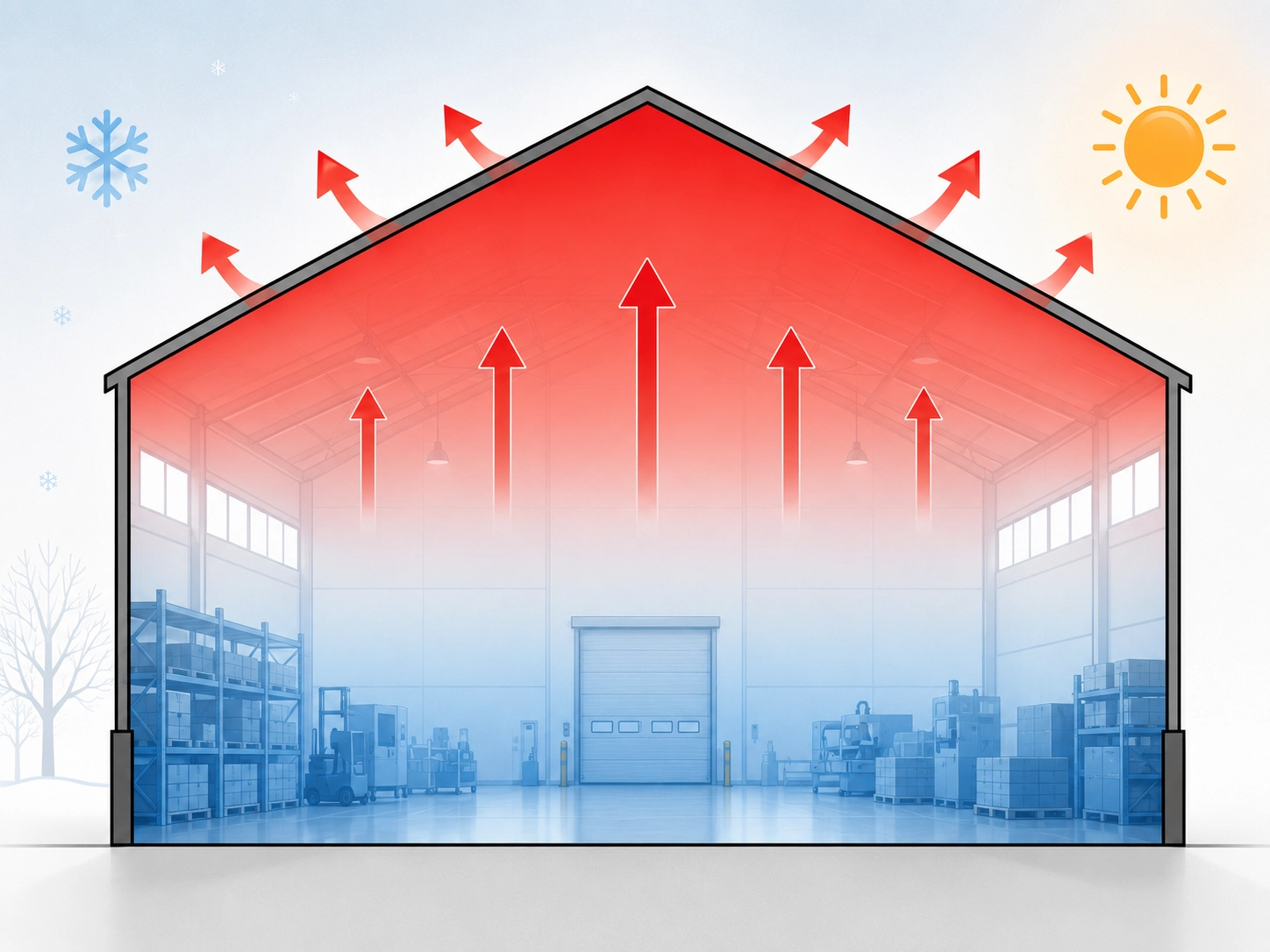
Without heat recirculation, warm air accumulates in the upper areas of industrial buildings. This increases heat loss through roofs and exhaust ventilation, while less warmth reaches the occupied zone. The result: higher energy costs in winter and excessive heat build-up in summer.
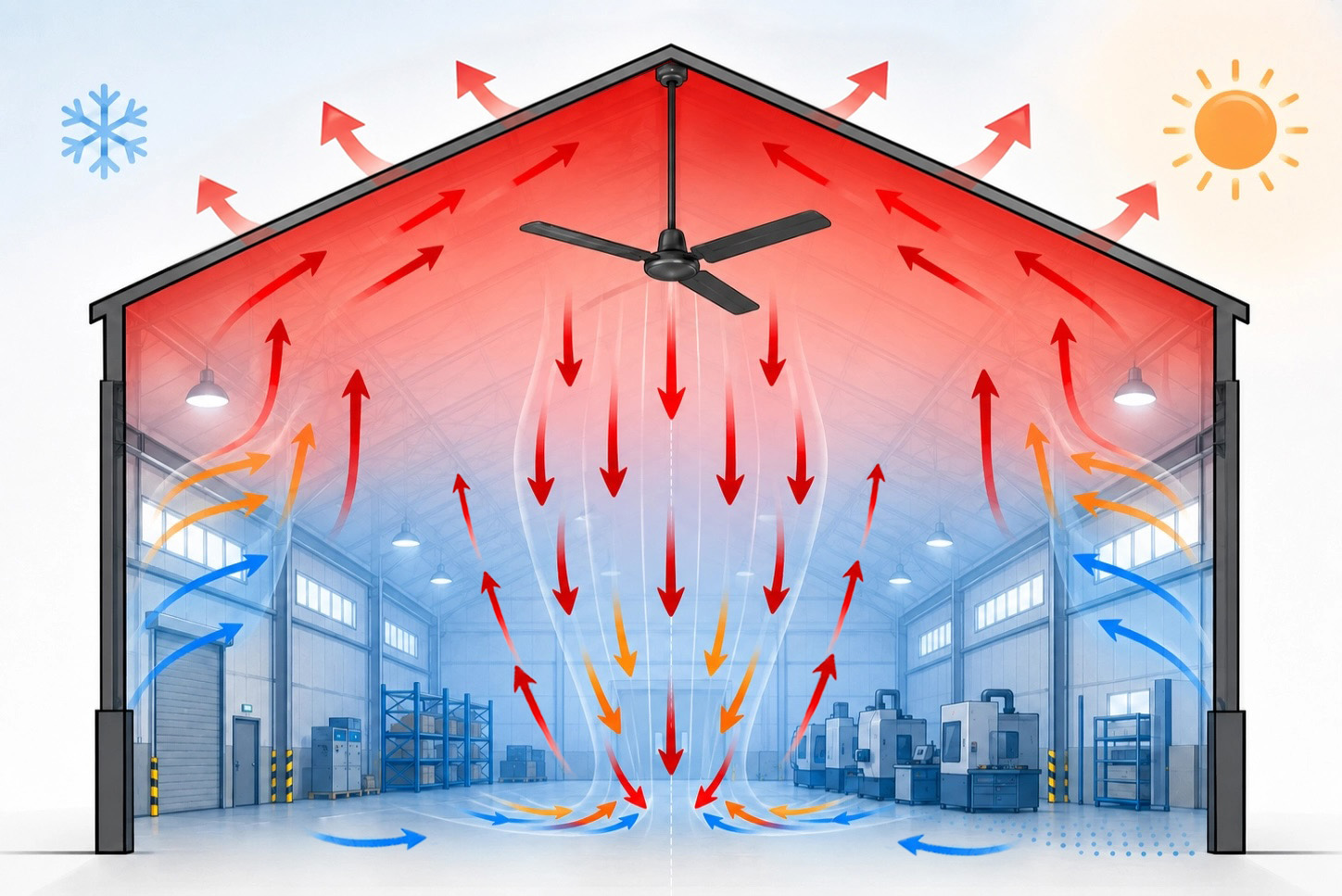
Conventional ceiling fans are often not designed for targeted heat recirculation. High rotational speeds can create uncomfortable draughts and increase upward heat movement, while low speeds may not be sufficient to achieve uniform temperature distribution.
ThermoReturn directs warm air back towards floor level using specialised, patented airflow technology. This creates more uniform temperatures, reduces cold zones and improves heating efficiency. The EC motor ensures energy-efficient and exceptionally quiet operation.
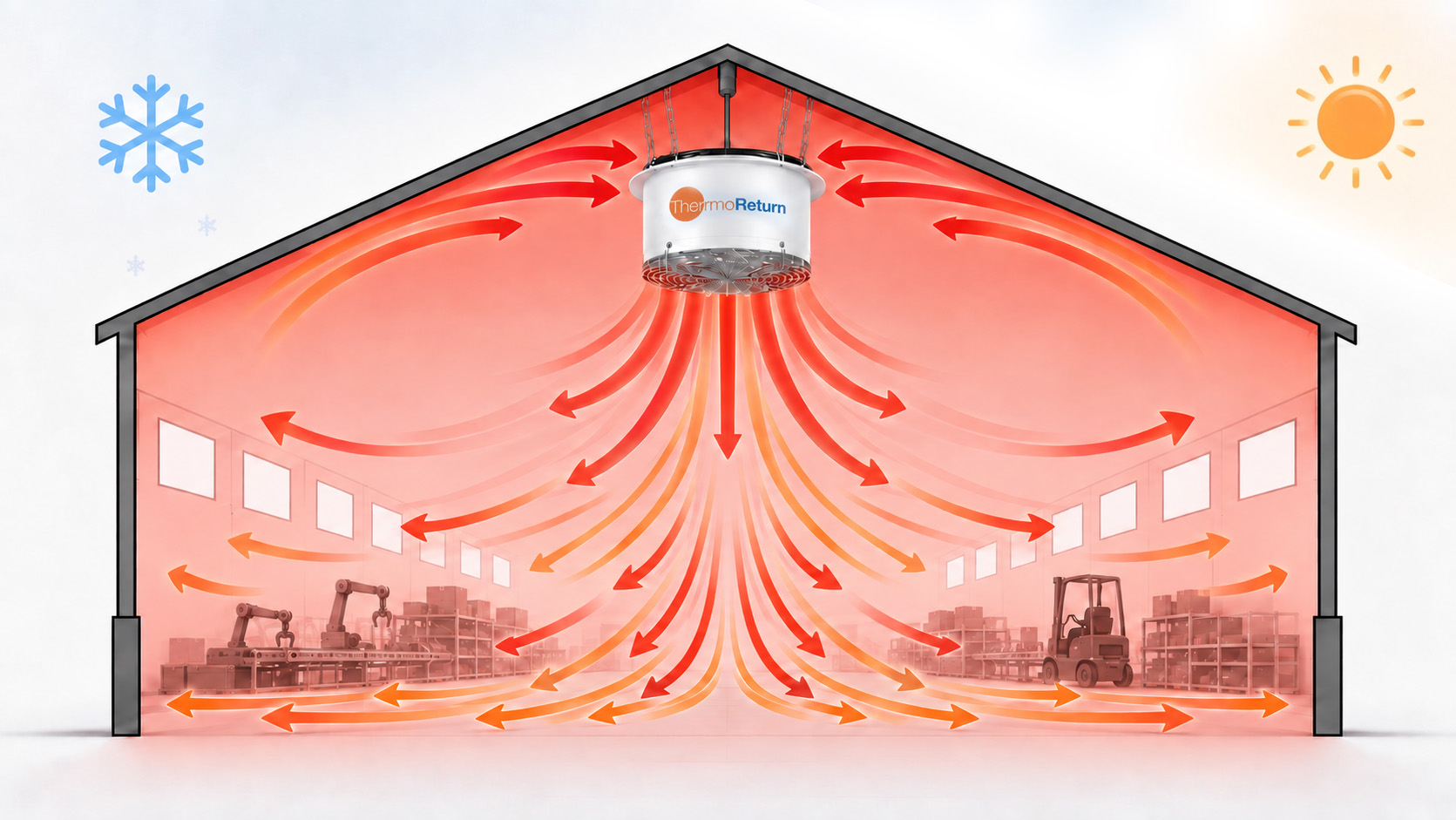
Warm air accumulated near the ceiling is deliberately redirected into the occupied zone.
Documentable energy savings and CO₂ emission reductions.
Supports the storage of temperature-sensitive products and goods.
Winter: Heat recirculation.
Summer: Ventilation.
Reduced condensation and corrosion in industrial facilities.
Independent of existing heating systems, making it ideal for both new and existing buildings.
Actual savings and performance depend on the building and operating conditions, including building height, insulation, heating system, ventilation, usage, animal species and weather conditions.
Measurements using distributed temperature and humidity sensors show:
Without ThermoReturn, heat and humidity are distributed unevenly throughout the space. Once the ThermoReturn system is activated, warm air from the ceiling is circulated downwards in spherical-radial patterns. Heat becomes significantly more evenly distributed and daily heating operating times may decrease.
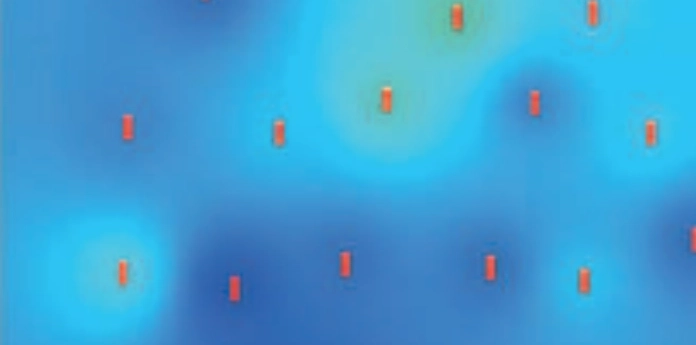
Floor level: The heating system starts when the temperature falls below the setpoint.
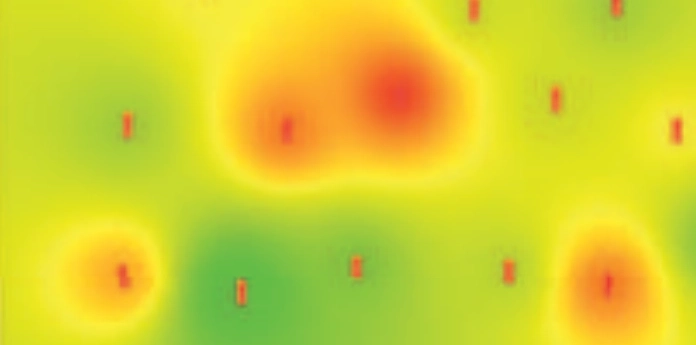
Floor level: Temperature and humidity remain unevenly distributed.

Floor level: Temperature and humidity are distributed more evenly throughout the space.
Results depend on the building and operating conditions. The measurement setup, building type, heating system, ventilation and operating conditions all influence the results.
Understanding the climate benefits of heat redistribution
This section explains key ESG terms and EU climate targets in the context of the ThermoReturn ceiling fan.
Buildings account for around 40% of energy consumption in the EU. Heat redistribution in halls and production buildings is one of the most cost-effective ways to reduce energy consumption, with a direct impact on CO₂ emissions, ESG indicators and compliance requirements.
The ThermoReturn ceiling fan delivers documentable savings that can be incorporated directly into sustainability reports and CSRD documentation.
Environmental, Social, Governance: an international framework for assessing corporate sustainability performance. The Environmental pillar covers measures to reduce CO₂ emissions and energy consumption. The ThermoReturn ceiling fan directly addresses both.
The environmental pillar of the ESG framework. It assesses factors including a company’s energy consumption, CO₂ emissions, resource efficiency and climate protection measures. Using the ThermoReturn ceiling fan as an energy-saving measure directly improves a company’s environmental indicators.
A document in which companies transparently present their environmental, social and governance performance. Under the CSRD, sustainability reporting is becoming mandatory for many companies. The documentable energy savings achieved with the ThermoReturn ceiling fan provide concrete indicators for this report.
The total amount of CO₂ emissions caused directly or indirectly by a company, product or activity. By reducing heating energy demand, the ThermoReturn ceiling fan lowers a building’s carbon footprint in a measurable and documentable way.
Direct greenhouse gas emissions from owned or controlled sources, such as burning gas or oil in a company’s own heating system. More efficient use of heating energy through heat redistribution directly reduces a company’s Scope 1 emissions.
Indirect greenhouse gas emissions from the consumption of purchased energy, particularly electricity. As the EC motor in the ThermoReturn ceiling fan consumes significantly less electricity than conventional AC motors, its use also reduces Scope 2 emissions.
The European climate protection programme aimed at making Europe climate-neutral by 2050. Part of the Green Deal is to reduce greenhouse gas emissions by at least 55% by 2030 compared with 1990. Energy efficiency measures such as heat redistribution contribute directly to this goal.
The EU has committed to reducing greenhouse gas emissions by at least 55% by 2030 compared with 1990 and achieving climate neutrality by 2050. Buildings account for around 40% of energy consumption in the EU, making energy efficiency measures in halls and buildings a key means of achieving these targets.
An EU directive aimed at increasing energy efficiency. It requires companies and public bodies to implement energy efficiency measures and carry out energy audits. Heat redistribution systems such as ThermoReturn are typical measures considered during energy audits.
The EU directive on corporate sustainability reporting. It requires companies above certain size thresholds to document their ESG performance in detail, including energy consumption and CO₂ emissions. The documentable energy savings achieved with the ThermoReturn ceiling fan can be included directly in CSRD reporting.
An EU regulation for classifying sustainable economic activities. It defines which investments and measures qualify as environmentally sustainable. Energy efficiency measures in buildings, such as installing heat redistribution systems, may qualify as taxonomy-aligned investments under certain conditions.
EU Regulation (EU) 2024/1834 on ecodesign requirements for fans under the Energy-related Products framework. It sets stricter efficiency requirements for industrial fans from July 2026. The ThermoReturn ceiling fan complies with EU ErP 2026 requirements and protects operators against mandatory retrofits.
The process of gradually reducing CO₂ emissions across the economy and society. Energy efficiency in buildings is a key component of decarbonisation strategies. Heat redistribution reduces heating demand and therefore directly reduces CO₂ emissions.
A state in which a company or economy no longer produces net greenhouse gas emissions because all emissions are balanced through reductions or offsets. Energy efficiency measures such as ThermoReturn contribute directly to a net zero strategy.
A state in which the greenhouse gas emissions of a company or building have been reduced to net zero. Heat redistribution is one of the most cost-effective ways to reduce heating energy demand and therefore contributes directly to climate-neutral buildings.
A systematic analysis of a company’s or building’s energy consumption to identify potential savings. Heat redistribution systems such as ThermoReturn are typical recommendations arising from energy audits for hall buildings.
A building designed, constructed or operated in accordance with environmental and energy efficiency standards. The ThermoReturn ceiling fan contributes to a building’s green credentials through documentable energy savings and CO₂ reductions.
The ThermoReturn ceiling fan is more than an energy-saving product. It makes a documentable contribution to your company’s ESG strategy.
Scope 1 and Scope 2 emissions are reduced, the building’s carbon footprint decreases measurably and the savings achieved can be included directly in sustainability reporting.
Future-ready, compliant with EU ErP 2026 requirements and made in Germany.
Would you like to assess the potential savings for your building? Get in touch.
For commercial projects, funding may be available in individual cases through energy efficiency programmes, such as the German Federal Funding Programme for Energy and Resource Efficiency in Industry. Depending on the funding scheme, applications may be submitted for grants through BAFA or Förderzentrale Deutschland, or for loan-based financing through KfW.
The eligibility of a specific ThermoReturn project must be assessed by a qualified energy consultant or funding specialist before placing an order or starting the project.
ThermoReturn does not provide funding advice and does not guarantee funding approval.
We are happy to provide personal advice with no obligation.
Glossary
FAQ
Clear explanations of technical terms relating to heat recirculation, fan technology, control systems, standards and compliance.
The deliberate elimination of temperature layers within a room. In buildings with high ceilings, warm air accumulates beneath the roof while the occupied zone remains cold. Destratification brings this warm air back down.
An active process that returns heating energy accumulated beneath the ceiling to occupied and working areas. It reduces heating demand, lowers energy costs and contributes to a comfortable indoor environment.
A physical phenomenon in which warm air accumulates at higher levels because of its lower density. In buildings with high ceilings, this can create a temperature difference of up to 15°C between the ceiling and floor areas.
The natural movement of heat caused by differences in air density. Warm air rises while cold air sinks. This is one of the main causes of thermal stratification in tall spaces.
Heat loss through building components such as roofs, walls and windows. The higher the temperature beneath the roof, the greater the transmission heat loss to the outside.
Describes how evenly or unevenly temperature is distributed within a space. Uniform temperature distribution means that temperatures remain approximately the same throughout the occupied area.
Indoor conditions in which temperature and humidity are distributed as evenly as possible throughout the space, without cold zones, hot spots or uncomfortable draughts.
An area within an industrial hall or livestock building where the temperature is significantly lower than in the surrounding space. Cold zones typically occur near external walls, doors and floor-level areas.
An accumulation of warm air beneath a building's ceiling. ThermoReturn actively uses this stored thermal energy by returning it to the occupied zone instead of generating additional heat.
The conversion of water vapour into liquid water when warm, humid air comes into contact with cold surfaces. In industrial buildings, condensation can cause moisture damage to machinery, shelving and the building structure.
Electronically Commutated Motor. A highly efficient electric motor with continuously variable speed control that consumes significantly less electricity than conventional AC motors, particularly during partial-load operation.
Alternating Current Motor. A conventional motor technology with more limited speed-control capabilities and higher electricity consumption compared with EC motors.
An advanced EC motor with particularly high efficiency. It enables economical, quiet operation and continuously variable speed control, even at high rotational speeds.
Operating a motor at reduced output below its maximum speed. EC motors are particularly efficient under partial-load conditions and consume proportionally less electricity than conventional AC motors.
A specialised protection system integrated into the ThermoReturn EC motor. It automatically releases condensation through a semipermeable membrane, protecting the motor against moisture damage.
Specially developed fan blades combining an aluminium support structure with a glass-fibre-reinforced plastic shell. Their curved shape is aerodynamically optimised to deliver high airflow performance with very low noise emissions.
A special ThermoReturn version offering two operating modes: downward heat recirculation in winter and active upward exhaust airflow in summer. This allows accumulated heat to be expelled through existing roof openings.
A specialised ceiling fan designed to eliminate temperature layers in tall spaces. ThermoReturn differs from conventional ceiling fans through its specialised airflow technology.
The technical principle by which the ThermoReturn fan circulates air downwards in spherical-radial patterns. This creates uniform air distribution without uncomfortable draughts, even in complex industrial buildings with tall installations.
A protective device fitted to the underside of the fan. In accordance with German accident prevention regulations, it protects people from the rotating fan impeller.
A protection rating for electrical equipment. IP64 indicates complete protection against dust and protection against splashing water from all directions, making it suitable for demanding industrial and livestock environments.
German occupational accident prevention regulations. They define safety requirements for workplace machinery and equipment, including requirements for protective grilles and ceiling fan suspension systems.
A precise temperature sensor based on platinum resistance. Installed near the ceiling, it measures the actual temperature as the basis for ThermoReturn's automatic control system.
A standardised control signal used in industrial systems. It allows continuously variable fan speed control between 0% and 100% and is compatible with many building management systems.
A central system for monitoring and controlling technical building equipment. ThermoReturn ceiling fans can be integrated into existing building management systems.
The professional management of buildings and infrastructure. ThermoReturn ceiling fans can be integrated into existing facility management processes and technical building structures.
A standalone ThermoReturn control unit for buildings without an existing building management system. It measures the actual ceiling temperature and automatically controls multiple fans, with manual operation and an optional timer.
A control strategy that automatically activates the fan when the temperature difference between the ceiling and floor areas exceeds a defined threshold.
EU Regulation (EU) 2024/1834 on ecodesign requirements for fans under the Energy-related Products framework. It introduces stricter efficiency requirements for industrial fans from July 2026. The ThermoReturn ceiling fan complies with EU ErP 2026 requirements.
Corporate Sustainability Reporting Directive. An EU directive concerning sustainability reporting. Documented energy savings achieved through ThermoReturn can be included in sustainability reporting.
Standards relating to heating, ventilation and air-conditioning systems, including indoor air quality, temperature distribution and thermal comfort in buildings. ThermoReturn supports uniform temperature distribution.
A designation of origin for products developed and manufactured in Germany. The ThermoReturn ceiling fan carries this quality designation.
A technical invention legally protected by a patent. ThermoReturn's airflow technology is patented, providing legal protection against direct imitation.
A reduction in heating costs achieved by using previously generated heat more efficiently. Heat recirculation can reduce daily heating operating times and therefore lower energy consumption.
The period required for an investment to pay for itself through the savings achieved. For energy-saving measures such as ThermoReturn, the payback period is primarily determined by reduced heating costs.
Carbon dioxide emissions resulting from energy consumption. Lower heating energy demand can reduce CO₂ emissions and improve a building's environmental performance.
The relationship between useful output and energy input. The more efficiently a system operates, the more useful performance it delivers with less energy consumption.
An accumulation of heat within an enclosed area, for example beneath the roof of an industrial building during summer. ThermoReturn's reverse function can actively direct this accumulated heat upwards.
Answers about functionality, potential savings, technology, applications and sustainability.
A heat recirculation ceiling fan is an industrial high-efficiency fan installed beneath the ceiling. It directs accumulated warm air back into the occupied zone without creating uncomfortable draughts. Unlike conventional ceiling fans, ThermoReturn uses specialised airflow technology to achieve uniform temperature distribution throughout the room, without modifying the existing heating system.
Destratification refers to the elimination of temperature layers within a space. In buildings with high ceilings, warm air accumulates beneath the roof, where temperatures can be 10 to 15°C higher than in the occupied zone near the floor. Destratification deliberately moves this warm air downwards, creating a more uniform temperature distribution.
Heat recirculation describes the process of actively returning heating energy accumulated beneath the ceiling to occupied and working areas. This can reduce heating energy consumption by making use of existing warm air instead of generating additional heat.
EU ErP 2026 refers to EU Regulation (EU) 2024/1834 on ecodesign requirements for fans under the Energy-related Products framework. It introduces stricter efficiency requirements for industrial fans from July 2026. The ThermoReturn ceiling fan meets these requirements.
In practice, heating cost savings of up to 30% can be achieved. Actual savings depend on several factors, particularly building height, insulation, heating system, ventilation conditions, type of use and weather conditions.
The payback period depends on current energy costs and the savings achieved. In many cases, the investment pays for itself through reduced heating costs within a comparatively short period. ThermoReturn can provide an individual cost-effectiveness calculation upon request.
Thermal imaging measurements and monitoring campaigns using distributed temperature and humidity sensors document the effects. After activating the ThermoReturn ceiling fan, heat can become more evenly distributed, heating system restart times may be delayed and daily heating operating times may decrease. Specific results depend on the building and operating conditions.
Yes. The ThermoReturn ceiling fan is optionally available with a reverse function. This allows switching between heat recirculation in winter and active exhaust airflow in summer. Warm air can be directed outside through existing roof openings.
The ThermoReturn ceiling fan is designed for buildings with high ceilings starting at approximately four metres. Typical applications include production facilities, warehouses, high-bay storage facilities, livestock buildings, greenhouses, wholesale markets, supermarkets and DIY stores.
ThermoReturn offers different performance classes: ThermoReturn small for ceiling heights up to 12 metres, ThermoReturn medium for ceiling heights up to 18 metres and ThermoReturn large for taller spaces.
ThermoReturn reverse is also available. This version can switch between downward heat recirculation in winter and active upward exhaust airflow in summer.
The selection depends on ceiling height, floor area, structural installations, ventilation conditions and the heating system. ThermoReturn assists in selecting and positioning the appropriate performance class.
No. The ThermoReturn ceiling fan operates independently of the existing heating system and can be retrofitted. It complements existing heating technologies, including gas, oil, district heating and heat pumps.
The ThermoReturn ceiling fan can be integrated into existing building management or facility management systems.
For buildings without existing control technology, ThermoReturn offers a standalone energy-saving controller with a PT100 temperature sensor, continuously variable 0–10 V control, manual operation and an optional timer. The controller is protected by an IP64 enclosure.
Thanks to its high-efficiency EC motor and aerodynamically optimised hybrid-structure sickle-shaped blades, the ThermoReturn ceiling fan operates with exceptionally low noise levels, even at higher rotational speeds.
The ceiling fan is designed for demanding environments. Its die-cast aluminium electronics enclosure provides corrosion protection, the Moisture Protection System automatically releases condensation to the outside and its stainless steel suspension eyes meet the specified safety requirements.
Yes. The ThermoReturn ceiling fan is suitable for heated livestock buildings, including pig, calf and poultry housing. It improves temperature distribution from floor to ceiling and can reduce cold zones in resting and feeding areas.
Draughts, cold zones and significant temperature fluctuations are recognised stress factors in livestock farming. They can affect animal health, feed intake and productivity. Maintaining the most uniform possible indoor climate therefore also has economic importance.
Yes. In greenhouses, the ThermoReturn ceiling fan supports more uniform temperature and humidity distribution across the growing area. Natural day-night fluctuations generally remain; the system primarily balances local temperature differences within the space.
When heat recirculation reduces heating energy demand, the building's associated CO₂ emissions may also decrease. The energy savings achieved can be documented and considered in relevant sustainability reports.
Documented energy savings achieved through ThermoReturn can be included in a company's sustainability reporting as an energy efficiency or CO₂ reduction measure. The specific information required depends on the reporting obligations applicable to the individual company.
Yes. According to the manufacturer, the ThermoReturn ceiling fan meets the requirements of EU Regulation (EU) 2024/1834 under the ErP requirements applicable to fans from 2026.
ThermoReturn GmbH
Leibnizstraße 83
10625 Berlin
+49 151 42467182
We use strictly necessary technologies to provide our website securely and store your privacy preferences. Optional services are only activated with your consent. You can change your preferences at any time. For more information, please see our privacy policy.
Choose which optional services you allow us to use. Strictly necessary functions are always active.
ThermoReturn GmbH
Imprint | Terms & Conditions | Policy Privacy | Cookie Settings